Just had to figure this out so thought I'd share it. You need the full (Pro) Acrobat to save rotated files, but there is a free (limit 10MB) site that allows you do this and save the file...
Friday, 17 April 2015

Monday, 10 November 2014
The Rom-Com Audience
HOW TO RESEARCH GENRE AUDIENCE?
To go about investigating the rom-com audience I would consider:
I've had a quick look at some of these, and have picked out just a few points below. Be clear on why you are researching the nature of any genre's audience (or market):
To go about investigating the rom-com audience I would consider:
- online searches, variations of 'rom-com box office' with other keywords such as 'uk' 'world' 'all-time' etc
- blogs and columns dedicated to box office analysis, not least the Film Guardian series on UK, US or global box office
- check the Wiki entry to see if there is a box office list/discussion

Images + video/audio clips were included in this audience research vid - look up book indexes and have a flick through magazines/journals such as Sight and Sound or the Media Magazine
- have a look at the archive (and links lists) on my BritishCinema, AS Coursework and Rom-Com blogs
I've had a quick look at some of these, and have picked out just a few points below. Be clear on why you are researching the nature of any genre's audience (or market):
Saturday, 18 October 2014
Wednesday, 1 October 2014
Film Opening EG Atonement (Joe Wright, 2007)
opening 2mins/titles of...
ATONEMENT
(Joe Wright, 2007)
Produced by Working Title (+2); distribution: Universal
Budget:$30m
Box Office: $130m (world); $51m (USA), £11.5m
WT's relationship with NBC-Universal; WT box office history to 2010; Convergence + Digitisation; Paul/Avatar essay guide; Some thoughts on the digitisation effect; Social realism.
THE OPENING (YOUTUBE):
SHOT BY SHOT BREAKDOWN:
ATONEMENT
(Joe Wright, 2007)
Produced by Working Title (+2); distribution: Universal
Budget:$30m
Box Office: $130m (world); $51m (USA), £11.5m
SUMMARY: A somewhat quirky (postmodern parody?) opening in which at least one central protagonist is firmly anchored, and signifiers abound of wealth, privilege and orderliness. Typical WT in some regards, although could be taken for another British production company and brand: Merchant Ivory.PREVIOUS POSTS THAT REFERENCE ATONEMENT:
WT's relationship with NBC-Universal; WT box office history to 2010; Convergence + Digitisation; Paul/Avatar essay guide; Some thoughts on the digitisation effect; Social realism.
THE OPENING (YOUTUBE):
SHOT BY SHOT BREAKDOWN:
Monday, 29 September 2014
Vloggers + UGC rivalling studios + conglomerates?
Certainly not a new topic this, although I haven't completed adding tags to the entire archive of posts, you'll see that 'UGC' (user-generated content) is a common topic (and I'll have a look to add 'vlogger' where appropriate: video-based bloggers).
I blog again on this as its a topic we've been discussing in recent lessons, and I've reflected on in recent posts. As Media students today, the demands on and expectations of you are higher than in the past - with the technology at your fingertips, there is an expectation of at least 'prosumer' levels of quality, ideally there being no clear indication (or anchorage) of your work as student productions at all.
The skills you're developing are highly marketable and valuable:
 |
| Gradually being updated - use the tag clouds! |
 |
| Fragment of a past post on this topic. |
The skills you're developing are highly marketable and valuable:
Friday, 26 September 2014
Queens, Kittens + QR Codes: Film about Media coursework
 |
| NB: Most DVDs have been packaged in a slimline case |
 |
| Click to enlarge; some info on what Movember is for |
YOU/audience are the product: Julian Assange
When we consider audience theory in Media Studies, the degree of flux and changing views on this is quickly evident, and a major theme in itself. Which, if any, of the long-established audience theories continue to hold true in the digital age, the web 2.0 era? Is it enough to write of "the former audience", Dan Gillmor's (2011) striking phrase? David Gauntlett even went as far as to declare the "end of audience studies" (2007, 2011), although Julian McDougall's (2009, in a very readable, student-friendly book) more moderate point that audiences are fragmenting, making it more difficult to meaningfully analyse or discuss/define audiences, is perhaps more useful.
There are those who see the blurring of the audience/producer line as full of democratic promise, not least Gillmor, though Henry Jenkins' Convergence Culture (2008) is perhaps the most striking statement of this.
On the face of it, the democratisation of 'UGC' (user-generated content), fan-made videos etc seems a good thing in weakening the power of the global conglomerate giants who dominate every media industry, often straddling several industries (as even the post-split Murdoch corporations do). But ... the 'new media' (an increasingly redundant term) giants have evolved themselves into even greater corporate behemoths than their old media predecessors. Is Wikileaks founder Julian Assange (still stuck in an asylum limbo in the Ecuadorian London embassy) right when he proclaims:
There are those who see the blurring of the audience/producer line as full of democratic promise, not least Gillmor, though Henry Jenkins' Convergence Culture (2008) is perhaps the most striking statement of this.
 |
| Is Jenkins too utopian, optimistic? [image source] |
On the face of it, the democratisation of 'UGC' (user-generated content), fan-made videos etc seems a good thing in weakening the power of the global conglomerate giants who dominate every media industry, often straddling several industries (as even the post-split Murdoch corporations do). But ... the 'new media' (an increasingly redundant term) giants have evolved themselves into even greater corporate behemoths than their old media predecessors. Is Wikileaks founder Julian Assange (still stuck in an asylum limbo in the Ecuadorian London embassy) right when he proclaims:
People who use Google are the product
Every time you go to a party and take a picture and post that picture to Facebook, you’re being a rat. You’re being a narc.
The first statement takes me back to the early days of my Media (and Politics) degree, when a simple enough statement immediately reformulated how I looked upon the media: newspapers sell readers to advertisers; when you buy a paper you're actually packaging yourself and selling yourself. Is the newspaper itself the product or a mere enticement for the actual product, a coalition of demographic types sufficiently attractive to a range of advertisers for the newspaper business to be economically viable?
 |
| A popular meme, Google is/Dr Evil [image source] |
Thursday, 25 September 2014
Following other blogs
Coursework groups should 'follow' each others' blogs, but you should also follow any of mine relevant to your AS/A2 course. There used to be clickable 'follow my blog' links on all blogger blogs, but no longer. Now, you go into your blogger dashboard, look for 'reading list', click add, copy/paste the blog URL (and click on 'add more' to add 3 at a time.
This means as part of your dashboard you'll see at a glance if there are any new posts on any blog you follow, and you can also click on that blog's name to get a list of all posts (and either click on a post title to go to that one post or the blog name to go to that blog in a new tab).
This means as part of your dashboard you'll see at a glance if there are any new posts on any blog you follow, and you can also click on that blog's name to get a list of all posts (and either click on a post title to go to that one post or the blog name to go to that blog in a new tab).
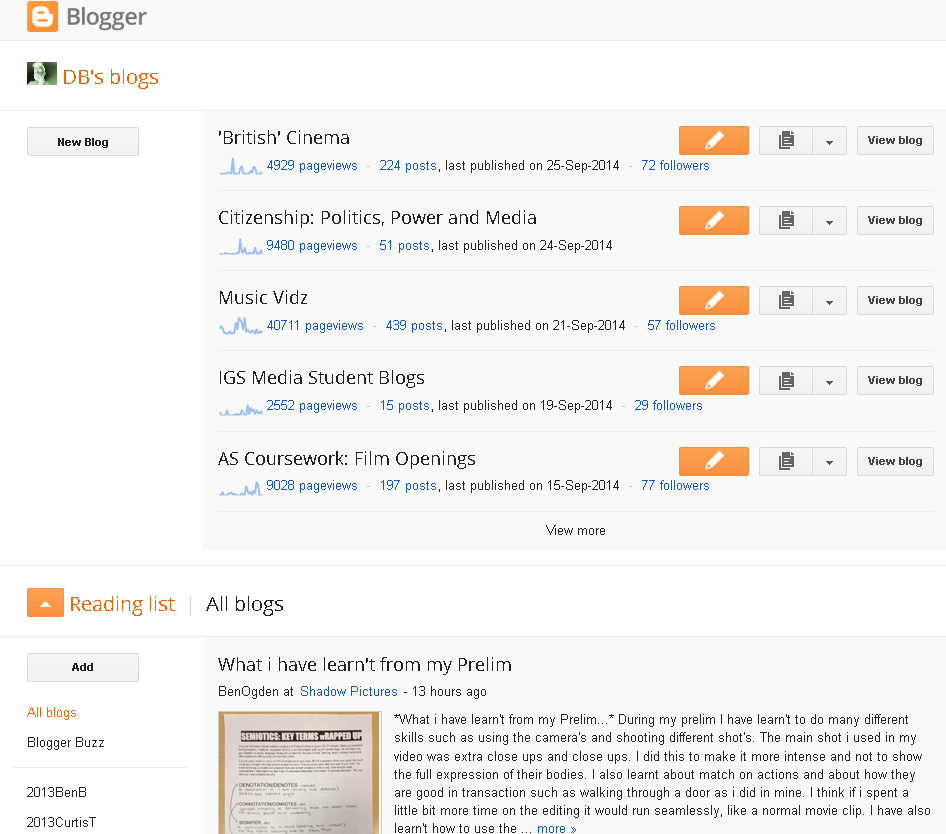 |
| My dashboard lists my own blogs in the top half; below it lists blogs I follow |
 |
| Just click on 'add' to get the window you see below, where you add blog URLs you want to follow |
 |
| You can add up to 3 at a time: click the '+Add' and you can add more |
Friday, 15 November 2013
Inside: Hollywood blurring audience/producer; are YOU?
 |
| 'Social film': blurring audience/ad/producer divide |
The fiasco of Snakes on a Plane showed that democratising and outsourcing creative work to an audience (in that case in an effort to create money-spinning buzz and awareness) can be a disaster, but we will most certainly see more and more of this. I've blogged elsewhere about examples of film production company Working Title's slick marketing campaign for films such as Tinker, Tailor, Soldier, Spy, which used online (spy-style) puzzles as part of multimedia campaign spanning supermarkets, posters and other such traditional fare with social media elements.
If you watch the short video below (3mins), ask yourself where the line is drawn here between audience and producer, and film and advertising (the title meshes with Intel's slogan, Intel inside), with the audience given chances to appear in the film and shape the script, whilst the blogs and other online videos and guides that sprang became part of the meta-text (a postmodern theory term).
Then ask yourself what use YOU are making of social media for producing your work. Have YOU used social media for...
- casting?
- initial genre/audience research through fan forums?
- generating pre-release buzz through a company blog/FB/Twitter/Instagram (etc!)?
- gaining audience feedback through any of the above (and YouTube/Vimeo of course)?
- used tagging/labels in Blogger/YouTube etc to attract more hits to help with the above?
- tried YouTube video responses/messages/comments to link to other film/video-makers?
- designed a viral-style campaign element which helps to involve an audience and increase publicity/awareness?
- generated and used a QR code as part of this?
- generally considered options for direct audience involvement in/influence on your production?
This is the film Inside, which is itself a good example of the viral methods used by conglomerates these days to get through to ad-weary and wary consumers (Toshiba and Intel were behind this movie): IMDB, Wiki, links to their FB/website etc are in this article. They coined the term 'social film' for this approach.
Prominence of student work on YouTube
I've blogged previously on the growing number of made-for-fun short
horror films on YouTube (especially zombie flicks), reflecting the ongoing impact of digitisation and the accessibility of digital film-making today, but its worth noting
too how the battalions of Media Studies students across the land are
leaving their own legacy. As students conduct research into their chosen
genre before setting out to create their own genre piece, increasingly
they could be accessing other students' distilled research to do so!
When doing some tagging on archive posts I came across a mention of how prominent my students' work was on YouTube search results - so, a year or so on, I had another look, and sure enough, a 'slasher openings' on YouTube (Nov 15th 2013) produced the following top results:
You can help make your work more widely seen by using YouTube categories and tagging.
When doing some tagging on archive posts I came across a mention of how prominent my students' work was on YouTube search results - so, a year or so on, I had another look, and sure enough, a 'slasher openings' on YouTube (Nov 15th 2013) produced the following top results:
 |
| IGS student work came top of the pile in this search |
Wednesday, 16 October 2013
Test screening - Alex Cox's Sid and Nancy
 |
| The UK poster |
I've blogged previously on how BJD initially looked doomed at its key stateside preview, with Miramax's head honcho Harvey Weinstein sat in with a US audience utterly baffled by the film's opening, with its very UK-centric turkey curry references (only for Colin Firth's oh-so-hilarious reindeer jumper to set the place roaring and BJD on to franchise fortunes).
Here's an example of a test audience utterly loathing the Alex Cox (Indie auteur) movie they'd just seen - usually a kiss of death, killing off any hopes of a distribution deal, but not in this case...
[Sid and Nancy] had a preview in LA - one of those events where the invited audience fills out forms and answers a studio's questions. these were some of the responses from the preview audience:
I feel this film was totally evil.
CREATIVITY: Alex Cox on Groupwork dynamics
 The following is extracted from the brilliant Indie auteur Alex Cox's X Films: True Confessions of a Radical Filmmaker (Soft Skull Press: Brooklyn, 2008). Writing about production of his debut feature, Repo Man (an archetypal cult movie - not to be confused with the Jude Law vehicle Repo Men),
he recalls being challenged over portraying a key female character as a
serial adultress. He thought his script was spot on, but then again ...
The following is extracted from the brilliant Indie auteur Alex Cox's X Films: True Confessions of a Radical Filmmaker (Soft Skull Press: Brooklyn, 2008). Writing about production of his debut feature, Repo Man (an archetypal cult movie - not to be confused with the Jude Law vehicle Repo Men),
he recalls being challenged over portraying a key female character as a
serial adultress. He thought his script was spot on, but then again ......I am a white male leftist, already guiltyu of the sins of sexism, racism, and generally wishy-washy-ism. As the days went by, I reflected regretfully on the adolescent sexism of my script. ... I [removed a] sex scene. Still I felt guilty: Debbie was still a poor excuse for a character ... I rewrote the liquor-store scene [giving her a heroic send-off].Have you reflected on the role collaboration played in your creativity? Remember, seeking out (at minimum) audience feedback implies that the audience/producer divide is questionable too! (cf. Gillmor's "the former audience" concept (2004))
This was a good idea. ... By alerting the director, the TV coordinator and casting director improved the picture. Could a film made by a group - where all take the role of a director, say - reach a decision like this? Presumably it could. Who knows? Maybe this interaction points to a more collaborative system, in which a group might make decisions more quickly.
(emphasis added; p. 59)
If you're willing to try out something a little different, you might just enjoy Repo Man...
Tuesday, 15 October 2013
Opening EGs: Pretty in Pink (Deutch, 1986)
 |
| Image from clothing shop promo, 2013 |
(this is an example of how you might blog on an example of a film opening; scroll right to the bottom for a key tip. You're not trying to cover every possible theme or point for each opening you analyse, just make sure you end up with 3+ clear examples on all key themes from your range of film opening posts for your summary post)
Howard Deutch, 1986
Paramount Pictures (prod. AND distrib.)
Budget: $9m; US box office: $40.5m
Opening duration: 2:30/4:41*
RottenTomatoes.com 81%; IMDB 6.6 ; Roger Ebert 4*.
LINKS: Wiki; YT trailer; IMDB; boxofficemojo.
*Scene in house up to 2:57; title theme comes in and out 'til 4:41
[the info above puts the film in context]
SUMMARY/IDEAS I MIGHT USE:
[its useful to pick out ideas/elements you might use] An opening of contrasts: grim mise-en-scene, but straight into the rom-com love triangle narrative. Surprisingly plain sans-serif titles and downbeat title theme song. Front-loaded with titles. Interesting gender representation: is Ringwald stereotype, countertype or a complex mix of both?
Tuesday, 1 October 2013
Prelims
When blogging on this remember to:
You will eventually have to answer an Evaluation Question (1 of 7) on this; you can find details on this here.
- state what the task is, using the exam board's explanation
- highlight + explain each of the 3 editing techniques required
- highlight + explain what continuity editing is
- note anything you've learned from using hardware or software (cameras, uploading footage, editing software + tools used, exporting an edited file), including screenshots where appropriate
- for any practical task reflect too on anything learned about planning, working with others/in a group etc
- upload to your own YT channel
- embed your prelim
- start all blog posts with PRELIM: (eg, PRELIM: The Task + the Techniques Included)
You will eventually have to answer an Evaluation Question (1 of 7) on this; you can find details on this here.
Monday, 30 September 2013
Blogging on sound in film openings
KEY TERMINOLOGY: NON-/DIEGETIC; AUDIO BRIDGE; ANCHORAGE; EXPOSITION; AMBIENT
Before planning and producing your own film opening, you should seek to research - and evidence this investigation - every aspect of film openings: narrative structure, idents, titles (credits and exposition), representations, audience targeting, genre signifying, mise-en-scene and verisimilitude, cinematography, editing, influence of budget, sound etc
Many of these elements could be investigated/discussed at the same time
The key to this is viewing a range of examples, taking notes and screenshots, and then presenting your findings in the form of well-illustrated blog posts and/or brief vodcasts. Screenshots (and occasionally short video sequences recorded using tools such as VLC - too long and it'll get banned from YT) are absolutely key, and should be saved too in named folders for re-use with your Evaluation and later posts explaining where your ideas come from.
This video assembles the titles of the Scream movies, which show that music isn't always the best means of signifying genre or setting a mood; a montage of sounds can work at least as well if mixed skilfully.
Before planning and producing your own film opening, you should seek to research - and evidence this investigation - every aspect of film openings: narrative structure, idents, titles (credits and exposition), representations, audience targeting, genre signifying, mise-en-scene and verisimilitude, cinematography, editing, influence of budget, sound etc
Many of these elements could be investigated/discussed at the same time
The key to this is viewing a range of examples, taking notes and screenshots, and then presenting your findings in the form of well-illustrated blog posts and/or brief vodcasts. Screenshots (and occasionally short video sequences recorded using tools such as VLC - too long and it'll get banned from YT) are absolutely key, and should be saved too in named folders for re-use with your Evaluation and later posts explaining where your ideas come from.
This video assembles the titles of the Scream movies, which show that music isn't always the best means of signifying genre or setting a mood; a montage of sounds can work at least as well if mixed skilfully.
Titles + Idents in Films vodcast task
 |
| This 2012 production took inspiration from Scream for its titles... |
I'd like each of you to create a simple vodcast on Titles + Idents in Film Openings.
Very simply, detail the idents that appear in each of the films (when listing the films, provide director, year, budget + box office summary) and then the titles that appear at the start of film as part of the film opening (which may mean at the conclusion of the opening - titles often appear once the sequence is concluded and, common with slashers, we start to pick up a second character travelling to the scene of the killing we've just seen).
Sunday, 29 September 2013
IDENTS Creating yours!
KEY FEATURES OF AN IDENT:
- COMPANY NAME
- JINGLE/SOUND
- GRAPHIC/VIDEO
- ANIMATION
CREATING AN IDENT USING LIVETYPE: JC VODCAST
FILM OPENINGS VODCAST1: IDENTS (DB)
One of the features the exam board (and general viewers via YT + events such as the Creative Arts Evening) most highly praise about AS work is the company idents featured at the start of them.
 |
| One of last year's wackier idents! |
LINKS LIST Task
•Log
in to blogger
•Go
to LAYOUT and click ADD A GADGET on the right side; find +
select LINKS LIST
•Give
it the title ‘Useful Slasher
Genre Resources’
•Separately
open http://dbhorror.blogspot.com/
•Using
my links lists/posts, add at least 5 links to your list, making sure you don’t
use the link for the link description
•Save,
then reposition so that your blog archive remains the top gadget
•If
there’s time left, add another gadget, an RSS feed: for Horror articles on The
Guardian (+ again reposition)
•If you hadn’t already, email me the
updated progress doc if you’ve made changes
Thursday, 21 February 2013
Standalone Company blogs
You should set up a company blog to represent your group production company; a fresh ident + logo for this would obviously be a useful addition (and can help with audience feedback).
In the listing of past blogs at http://asmediablogs.blogspot.co.uk/ I've included spearate links to company blogs (not all of which have that impressive!). Jonny/Joel's Vertigo Cinema, producer of A Bat in the Belfry (as featured in the 2011 Co-Op Film Festival), is a good example.
COMPANY BLOGS: WHAT TO INCLUDE...
STYLE/AUDIENCE:
In the listing of past blogs at http://asmediablogs.blogspot.co.uk/ I've included spearate links to company blogs (not all of which have that impressive!). Jonny/Joel's Vertigo Cinema, producer of A Bat in the Belfry (as featured in the 2011 Co-Op Film Festival), is a good example.
COMPANY BLOGS: WHAT TO INCLUDE...
STYLE/AUDIENCE:
Tuesday, 5 February 2013
Divshare + embedding podcasts/MP3s
Don't use YouTube for podcasts.
For the last several years we've used divshare without problems for uploading and then accessing embed codes for MP3 files. I tried it again today (5th Feb) just to check its still working - and, for my account at least (such sites sometimes take away free options for newer members), it is, as these screenshots demonstrate.
Sign up is simple, ditto uploading - remember, its for audio files NOT movie files.
And here it is...
There are other options if you don't see the SHARE button on divshare. Soundcloud works along similar principles, though it also has a handy record button so you can record podcasts directly to the site. For this example, I played a YouTube clip then hit the record button...
Here I tweaked the code I pasted in, changing the frame width to 70% and the height to 83. As you can see, it still works, you just don't see part of the soundwave graphic, and the icons are changed. You can play around with the size settings to make it fit according to your needs.
I haven't tried it, but freewebspace.net is another that came up from a simple free upload embed mp3 google.
For the last several years we've used divshare without problems for uploading and then accessing embed codes for MP3 files. I tried it again today (5th Feb) just to check its still working - and, for my account at least (such sites sometimes take away free options for newer members), it is, as these screenshots demonstrate.
Sign up is simple, ditto uploading - remember, its for audio files NOT movie files.
 |
| Logged in to my divshare account, I upload, find the file, and (as with YouTube) simply click the SHARE button |
 |
| This generates the embed code |
 |
| You can also click on ADDITIONAL SETTINGS below the code. If the player is too wide, reduce the width="335" |
There are other options if you don't see the SHARE button on divshare. Soundcloud works along similar principles, though it also has a handy record button so you can record podcasts directly to the site. For this example, I played a YouTube clip then hit the record button...
Here I tweaked the code I pasted in, changing the frame width to 70% and the height to 83. As you can see, it still works, you just don't see part of the soundwave graphic, and the icons are changed. You can play around with the size settings to make it fit according to your needs.
I haven't tried it, but freewebspace.net is another that came up from a simple free upload embed mp3 google.
Monday, 28 January 2013
Blogging class notes on film openings
 |
| The final girl/scream queen binary: Laurie has the school books, the scream queen has makeup! |
We're going to look today at the final girl archetype, Laurie Strode: read more about the theory behind this idea here.
 |
| Again, the scream queen smokes signifying her 'deviancy' |
Here's how I'd set out a post looking at a film opening.
POST TITLE: Needs to be kept brief, and a numbering system helps, either OpeningEG1: This is England or SlasherEG1: Halloween (orig).
Tuesday, 15 January 2013
Screenshots and screen recording
We can't quite afford the most popular choice for this - Camtasia - but there is software built into the Macs to capture screenshots (there are also keyboard shortcuts for this, blogged on earlier) and record the screen: "Grab"
You need to go into FINDER; APPLICATIONS; UTLILITIES; GRAB (or, in Finder just type Grab into the search box!)
This is the most effective means of showing how you've utilised software
You can also try QuickTime has has recording tools most people are unaware of (it also enables you to do basic edits).

You need to go into FINDER; APPLICATIONS; UTLILITIES; GRAB (or, in Finder just type Grab into the search box!)
This is the most effective means of showing how you've utilised software
You can also try QuickTime has has recording tools most people are unaware of (it also enables you to do basic edits).


Friday, 11 January 2013
FEmale gaze? Adapting Laura Mulvey
UPDATE, 2015: Rather
than add another post, I'll add to this one which looked at the example
of Magic Mike as an exemplar of an emerging female gaze. That was
rather limited to the notion of objectifying; I've added more below on
an article for Media Magazine by Sean Richardson in which he
challenges us to think more carefully about how a female viewer
(de)constructs and receives media images. Yes, media and not least
cinema remains somewhat patriarchal overall, but it is just too
simplistic to view media entirely through the prism of sexist
objectification.
The Female Gaze: Rethinking Representation
Following quotes are from an article in the always excellent Media Magazine (subscription needed - ask the Librarian or me for login details). Sean Richardson wrote in April 2015 on this topic, starting with a simple statement on the impact of male gaze:
The Female Gaze: Rethinking Representation
Following quotes are from an article in the always excellent Media Magazine (subscription needed - ask the Librarian or me for login details). Sean Richardson wrote in April 2015 on this topic, starting with a simple statement on the impact of male gaze:
Research suggests that advertising campaigns for a female audience are dominated by heterosexual Caucasian size 0 to 2 models. This is a fact, despite what we might think or want, in a multicultural, complex world. Increasingly, accusations have been made by the likes of Naomi Campbell and Dame Vivienne Westwood that representations of women in advertising are too white and nearly exclusively under size 6.
Monday, 17 December 2012
Slasher Genre Overview Vodcast
The idea behind this is simple: you individually summarise the knowledge you've gained from research into the slasher (aka slice'n'dice, aka stalk'n'slash etc) sub-genre of horror, then get together as a production group and compare notes, expressing your shared learning as an in-depth vodcast. It can be both useful and convenient to use one specific film to focus your analysis on (so long as you make a variety of links/examples to other films as you go). Strive to draw links between what you've found out and your current idea. Ideas will change, but as you continue with research take every opportunity to apply it: don't just dump down observations or quotes but clearly show you've reflected on how you might use (or even refuse!) such conventions as you discover. Endeavour to use semiotic terminology and precise media language generally (when discussing a sample scene/shot/edit or sound, provide clear denotation), and reflect on what you've learnt about film budgets and production contexts (Indie v studio) - basically, try to show off what you've learned to date! TRY HARD TO CITE/APPLY SPECIFIC THEORIES/THEORISTS AND BOOKS/ARTICLES - (BRIEF) DIRECT QUOTES WOULD BE GOOD!Research needs to be ongoing: keep watching + making/posting notes on film openings (or specific aspects of slashers, such as stalking scenes, that you plan to use) and any reading you're doing. You should already have undertaken a wide range of research, as reflected in your...
- Blogging on sample openings (everyone should have at least 10 slasher examples blogged on before we get to the 1st rough cut on 5th Feb)
Re-Pitches
More detail is provided at the original, main pitching post.You will, as a group, re-pitch twice: Weds Jan 9th WkB P5 + Tues Feb 12th WkA P1. Note, however, that I will frequently ask random group members to go through similar points without notes during lessons in Jan/Feb: every group member needs to be in clear ownership of the idea and production.
Re-pitches must be accompanied by suitable, relevant (audio-)visual material to illustrate your concept, in the form of a video clip that will not be paused (as before: one click to play only so nobody is hunched over a computer).
Also as before: any group that fails to deliver a convincing, very thorough re-pitch and/or fails to satisfactorily answer reasonable questions put to them by classmates or myself will have to re-pitch each lesson until this is achieved.
Use my detailed post and the notes sheet for guidance: you each need to be absolutely clear on evry aspect of your production. The re-pitches provide an opportunity to get feedback from your peers as well as me, including suggestions on improvements, changes or simply useful texts to view.
Every time you get feedback, whether from me, a classmate or other source, always reflect and blog - what change/s (if any) will you make as a result? That may include scheduling some reading or viewing, or additional shoots/location scouting etc. We will again film these re-pitches to give you the chance to fully reflect on everything that is said.
Thursday, 13 December 2012
Jan-Feb deadlines + details
The AS Media has 2 equally-weighted units: coursework and exam. Instead of separately working on each, we endeavour to fuse theory and practice throughout the year, using filming/editing exercises to enhance learning of theory, and using theory to enhance learning of filmmaking. Many of the case studies we explore can be used in exam essays.Students need to build up notes and resources for the 7 Evaluation Qs as we go, otherwise they are likely to struggle. Unpublished draft posts are a useful means of doing this. When pod/vodcasting, don't forget this post which has examples (including chatshow style vodcasts)and further links.
In this half-term we:
- Examine one area of representation each week (exam section 1 + coursework Evaluation Q2): gender, age, sexuality, regional identity, dis/ability, class & status (ethnicity next half-term)
- Progress to step 9 of 10 on coursework, having already gone through steps 1-4. This means researching + defining target audience; investigating + evidencing mise-en-scene considerations (costume, locations, props etc) + casting (including addressing representations); teaser trailer and treatment; storyboards, animatic, production schedule, screenplay; sample scenes + rough cuts.
- Take substantive notes on all 7 Evaluation Qs throughout the half-term; you will complete Q3 (distributor) and draft Q2 (representations).
- In the final week you re-pitch your production idea and revise the production schedule with principle shooting to be completed for returning on 25th March.
WEEK-BY-WEEK SUMMARY
Blogging on learning from the previous week’s lessons should be complete (multimedia and well presented) and updated for the following Monday, though students have the option of blogging instead of writing notes in lessons.
As most students work in groups for coursework, there are opportunities to divide up many of these tasks within the group.
WEEK-B 16 (7-11 Jan): 9th: Re-pitch. 11th: ‘Slasher Genre: An Overview’ vodcast (1 per production group, as is the case for all vodcasts unless stated). (Re-pitch; Genre Overview group vodcast)
WEEK-A 17 (14-18 Jan): 17th: Evaluation Q3 (distributor) completed. Also blog posts ‘Budget’, ‘Target Audience’ and ‘Distribution for our film’ which all overlap with Q3. (Q3; Posts on budget, tgt aud, distribution)
WEEK-B 18 (21-25 Jan): 22nd: ‘Casting, characters, & mise-en-scene’ vodcast. 25th: ‘Are we creating ‘British’ Cinema?’ (group) podcast or vodcast (your choice) for class discussion.
WEEK-A 19 (28-1 Feb): 31st: Teaser trailer + treatment.
WEEK-B 20 (4-8 Feb): 5th: Rough Cut1. 8th: Pre-production complete, including storyboards, schedule, call sheets, animatic + screenplay.
WEEK-A 21 (11-15 Feb): 12th: Rough Cut2 + re-pitch2 + final draft schedule, including blogging tasks. 14th: Final, revised schedule + essay ‘Representations within our production’.
I will explore the possibility of opening up K5 for one day during the break to enable uploading/editing footage if there is sufficient demand (requests via comments or email). Any outstanding filming should be completed before we return. Blog, final cut and all Evaluation Qs are to be completed for March 14th.
Wednesday, 5 December 2012
Pitches + genre: some pointers on slasher movies
Creature feature or unkillable killer: John Carpenter’s
slasher 1978 archetype Halloween (the
ending of the original where Myers has been shot but still disappears creates
the template for the unkillable killer), and Sean S. Cunningham’s 1980 gorefest
Friday the 13th
(Jason Voorhees swiftly becomes an inhuman creature) are the foremost examples.
A Nightmare on Elm Street (Wes Craven, 1984) adds a
neat twist of a creature killing through teens’ dreams, the late paedophile
Freddy Krueger having been burned to death by vengeful townsfolk wreaking his
bloody revenge. There are many others, often rather daft, such as the Child’s Play and Leprechaun franchises. Like Jason Isaac’s 2001 Friday the 13th X (better known as Jason X – great tagline:
“Evil gets an upgrade”), some slasher sequels have been set in space, such as Leprechaun 4: In
Space (Brian Trenchard-Smith, 1997 – not sure how it even managed to
get a 3.1 rating on IMDB!). The fifth
and sixth Leprechaun movies are set
in ‘the hood’ (sorry, tha hood).
Right there we have one of the keys to the slasher’s
enduring success: its capacity for hybridity,
Copyright and YouTube
Your final AS coursework production must not feature any copyrighted material, but some of your vodcasts might. Below I consider some of the issues and considerations involved.
Since YouTube introduced an automatic detection system (see the Wiki) and signed deals with most of the major TV, film and music companies (as you'll have seen from your Media work, these tend to be subsidiaries of massive horizontally and vertically integrated conglomerates such as News Corp and NBC-Universal), the issue of 'fair usage' of copyrighted materials has evolved a little.
 |
| Link at the end of the post: a very useful site for exploring the issue further |
 |
| My vodcasts used clips short enough to be considered 'fair usage' |
I've tried to find a definitive acceptable length of film clips which won't generate a YouTube blocked upload, without success so far (if you find anything on this please pass it on). I'd suggest aiming for 30secs or less, using freeze frames with original audio removed for anything over this, but that's a guess. Check your uploads for anything being blocked. So far, we've not problems with any A2 music videos, just AS film vodcasts (and a compilation of scenes which used a Depeche Mode a couple of years ago), including one of mine (vodcast on scream queens + final girls, available to view on request) in which I simply used too much of Bride of Chucky.
FairUseTube.org provide a very considered analysis of the issues involved, YouTube's policies and also highlight some of the common abuses - where fraudulent companies simply claim you've used their copyright material when that's not the case. I think I may have found one such dubious claim on my channel, for past AS coursework where the soundtrack was composed in school using GarageBand! In such cases, the fraudulent company pockets the money from ads which YouTube force on to the upload.
See http://fairusetube.org/dvd-ripping-guide; http://fairusetube.org/youtube-copyfraud; http://fairusetube.org/guide-to-youtube-removals and other such links on the site.
YouTube itself offers a guide, including lengthy videos, though they shy away from being specific over such matters as how much of a single TV show, film or other text goes beyond the fair usage doctrine - see also the Wiki on Fair Usage.
The Uni of Houston's DigitalStoryTelling site also features a considered discussion of the issues and legal policies.
Monday, 19 November 2012
Narrative/Representations in 3 slasher openings Task
This task links to one of your Evaluation questions as well as generally boosting your prospects of a good mark for the R+P (and giving you a good grounding in the genre you're working in).
The best work here will include some further reading from some of the many books purchased and in the Lib/classroom on horror, tho you should all also be using the horror blog too, and all should be referencing the concepts of final girls and scream queens, plus the male gaze theory, associated with feminist critics Carole Clover and Laura Mulvey.
Here's a couple of useful links:
http://www.horschamp.qc.ca/new_offscreen/final_girl.html
http://www.contamination.pwp.blueyonder.co.uk/books/books_theory.htm
THE TASK:
ANALYSE THE NARRATIVE STRUCTURE (CITING/APPLYING RELEVANT THEORIES) + REPRESENTATIONS (OF AGE, GENDER, SEXUALITY etc) IN 3 SLASHER OPENINGS
These can be slashers you've previously analysed.
Aim to accurately employ useful terminology from semiotics plus editing + other media language terms.
Aim to engage with the feminist writings of Laura Mulvey and Carole Clover, and provide your own take on their arguments through your discussion of the examples you're looking at.
 |
| A useful book, available in classroom/Lib/to buy! |
Here's a couple of useful links:
http://www.horschamp.qc.ca/new_offscreen/final_girl.html
http://www.contamination.pwp.blueyonder.co.uk/books/books_theory.htm
THE TASK:
ANALYSE THE NARRATIVE STRUCTURE (CITING/APPLYING RELEVANT THEORIES) + REPRESENTATIONS (OF AGE, GENDER, SEXUALITY etc) IN 3 SLASHER OPENINGS
These can be slashers you've previously analysed.
Aim to accurately employ useful terminology from semiotics plus editing + other media language terms.
Aim to engage with the feminist writings of Laura Mulvey and Carole Clover, and provide your own take on their arguments through your discussion of the examples you're looking at.
Editing in a sample stalk/slash scene
FOR THIS TASK YOU NEED TO REFER CLOSELY TO THE LIST OF TECHNICAL TERMS ISSUED AT THE START OF THE YEAR, AND ENDEAVOUR TO EMPLOY THE RELEVANT EDITING TERMS
This task is a test of your ability to deconstruct a media text - just as you do in both your exam and coursework Evaluation (in that case, its actually reconstructing your own media language decisions). You should endeavour to employ not just editing terminology, but also terms linked to narrative, semiotics, the genre and general shot type denotation.
Its up to you whether you decide to present it as an extended blog post heavily illustrated with screenshots or as a captured video clip with your own voiceover replacing all or most of the original audio (you can also simply reduce the volume level of the original material). Aim to keep captured clips short so they stay within the spirit of the fair usage copyright doctrine.
 |
| The flushing toilet struck a bum note in 1960; it broke a taboo! |
Its up to you whether you decide to present it as an extended blog post heavily illustrated with screenshots or as a captured video clip with your own voiceover replacing all or most of the original audio (you can also simply reduce the volume level of the original material). Aim to keep captured clips short so they stay within the spirit of the fair usage copyright doctrine.
If you're working on this when other classes are in K5, be mindful of the need not to expose younger students to unsuitable material.The task then:
Subscribe to:
Posts (Atom)